SigniStruct
A secure full-stack platform for creating, managing, signing, and verifying documents and forms in one workflow. It combines document editing, digital signature management, certificate-backed verification, and audit-ready tracking to streamline trusted approvals end to end.
Core Objectives
Authentication & Access
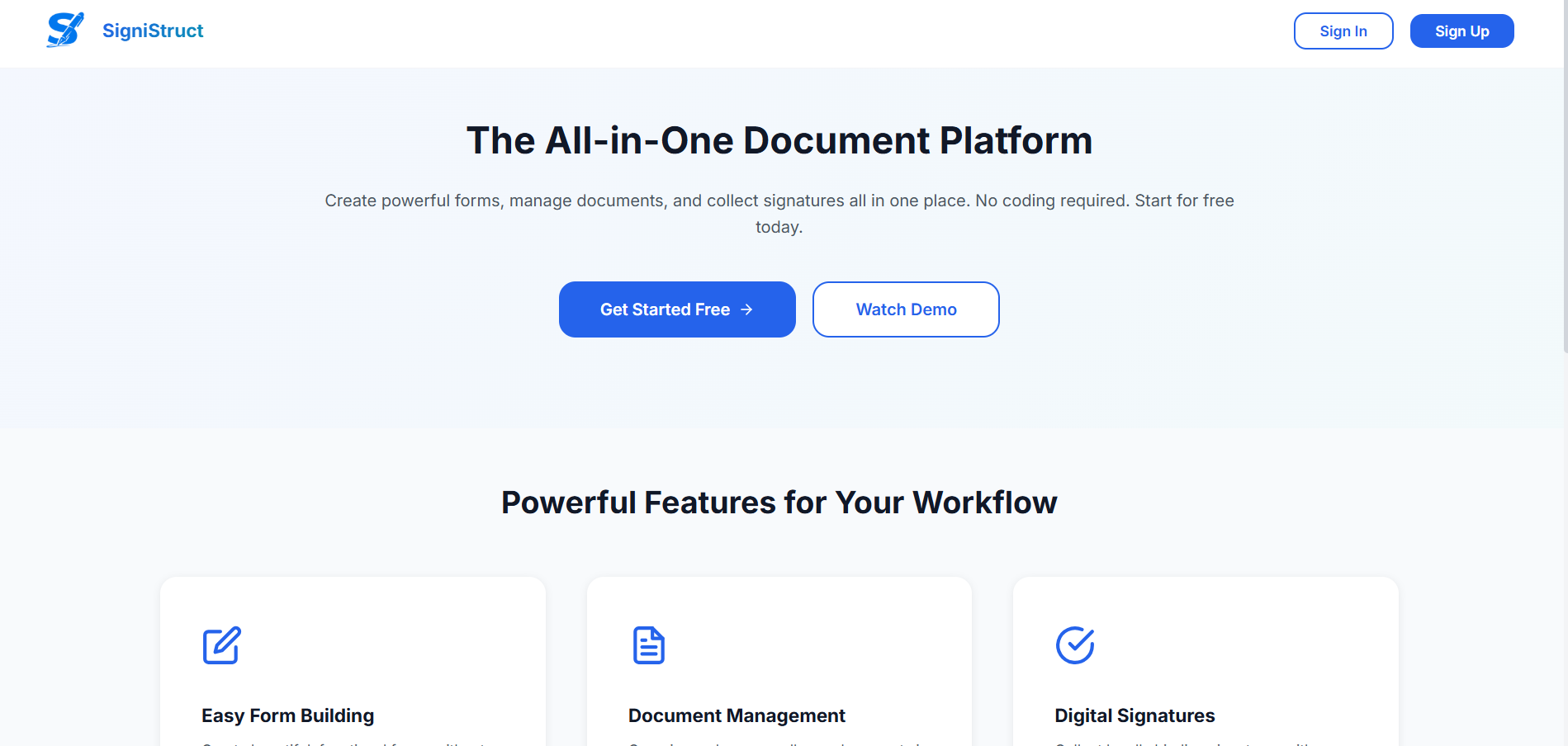
Landing Page
Introduces the product and routes users into the secure workspace.
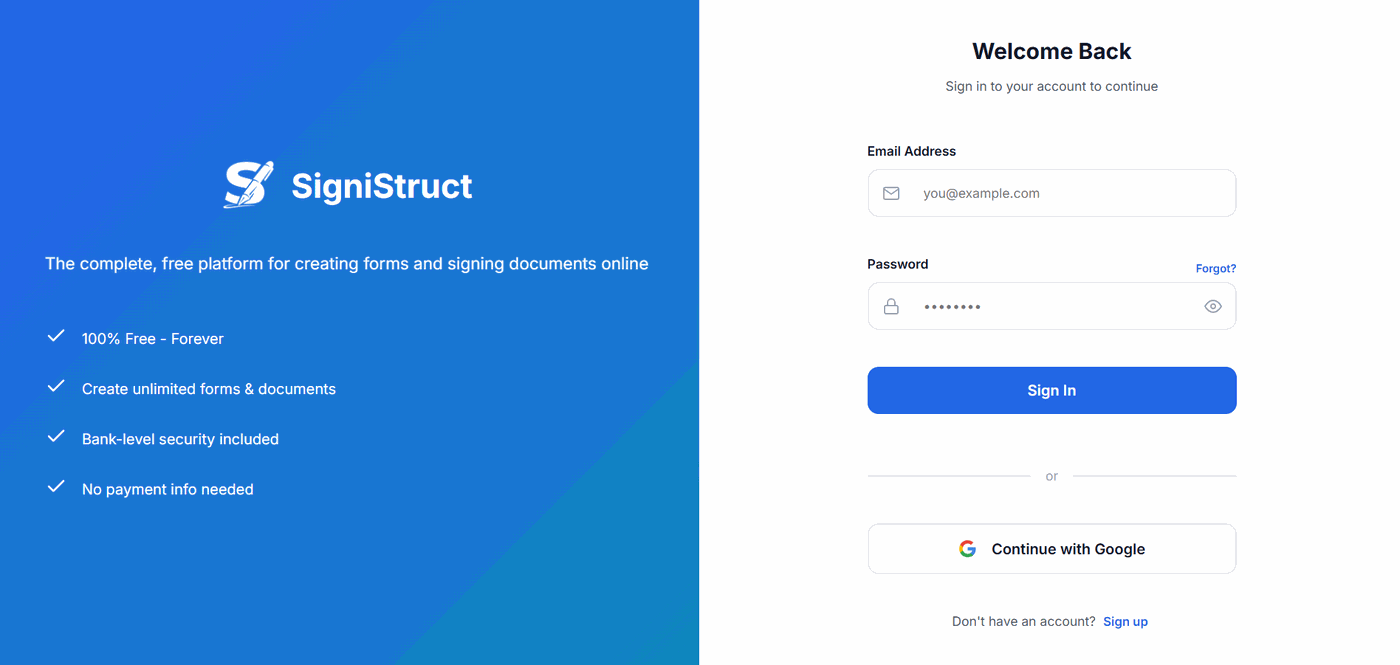
Sign In / Sign Up
Handles account access and onboarding through dedicated auth pages.
Auth Context
Keeps user state available across the app and supports protected navigation.
Route Guards
Shows authenticated pages only when the user is logged in.
Header Controls
Exposes logout and workspace navigation on protected screens.
Dashboard & Workspace
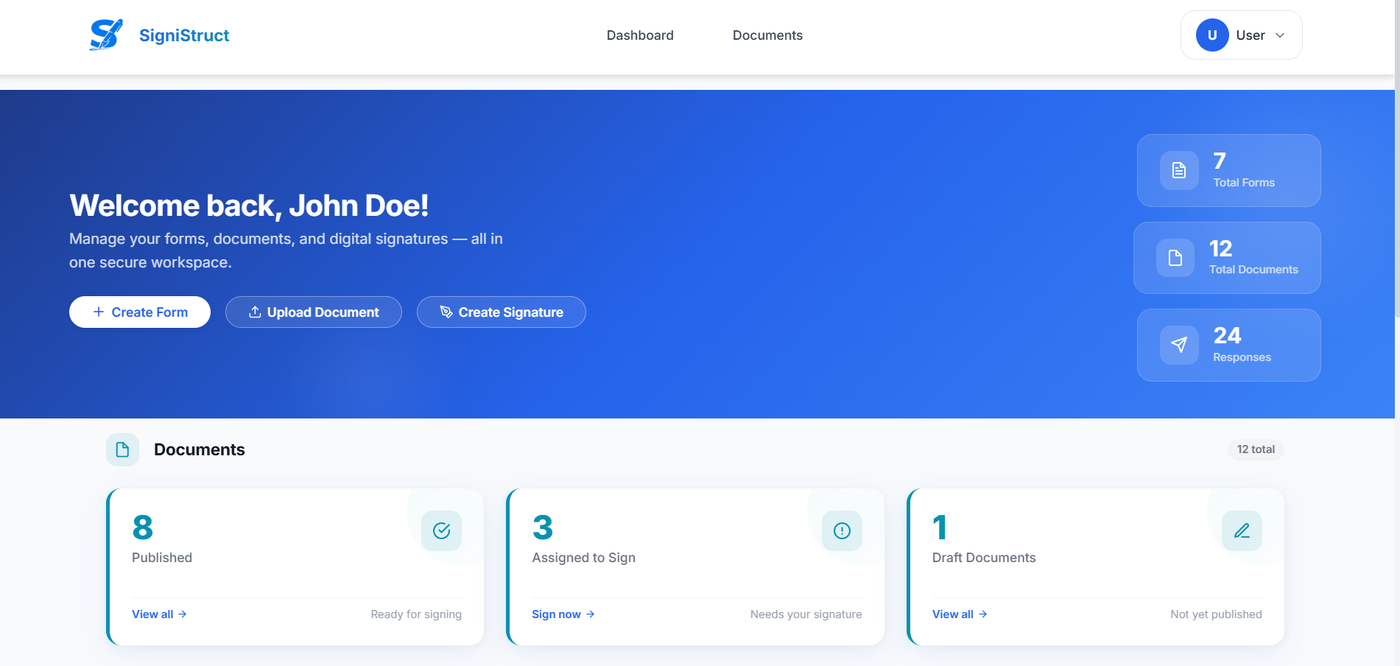
KPI Cards
Summarizes published forms, documents, responses, and signature counts at a glance.
Quick Actions
Lets users create forms, upload documents, or jump into signature management immediately.
Recent Activity
Displays a timeline of recent form creation, document signing, and pending work.
Forms Area
Provides the main place to build and manage form assets.
Documents Area
Organizes drafts, published files, and items assigned for signature.
Document Signing, Verification & Compliance
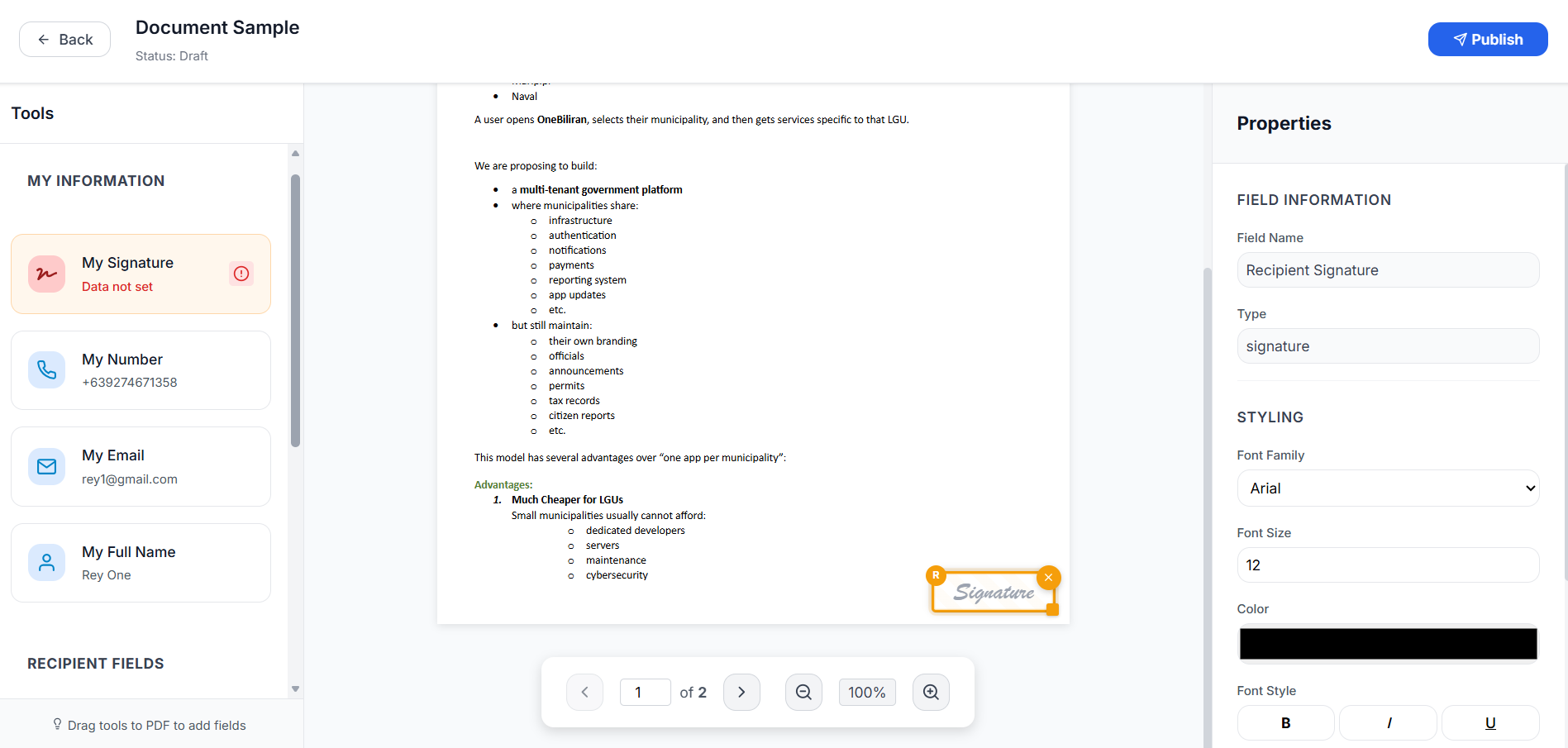
Document Editor
Splits the workspace into panels for viewing, editing, and placing signing fields.
Document Signing Flow
Supports tokenized signing routes for recipients completing a document.
Signature Creation
Lets users draw or upload a reusable signature and set a default option.
Certificate Management
Tracks signing certificates used for trust and verification.
Verification & Audit
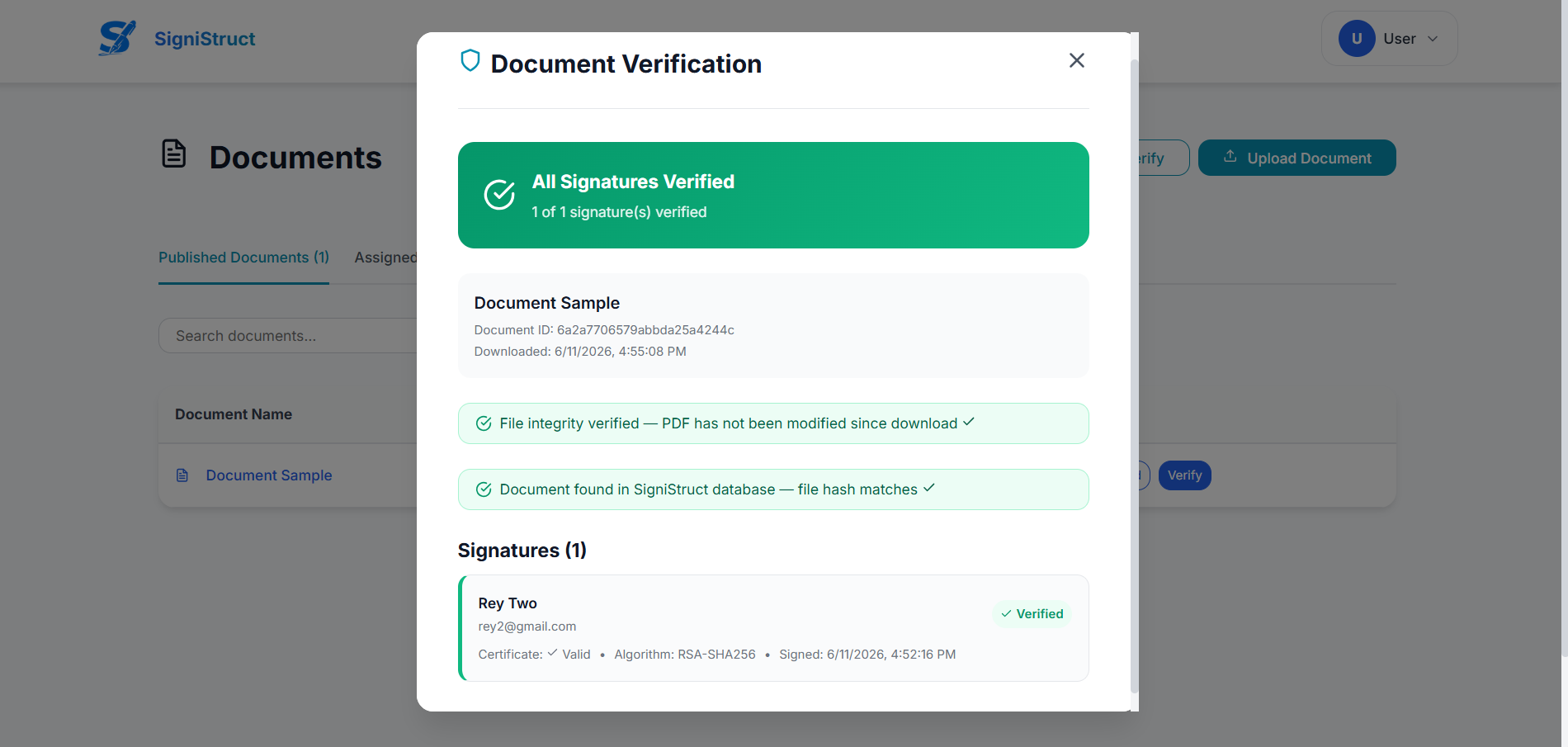
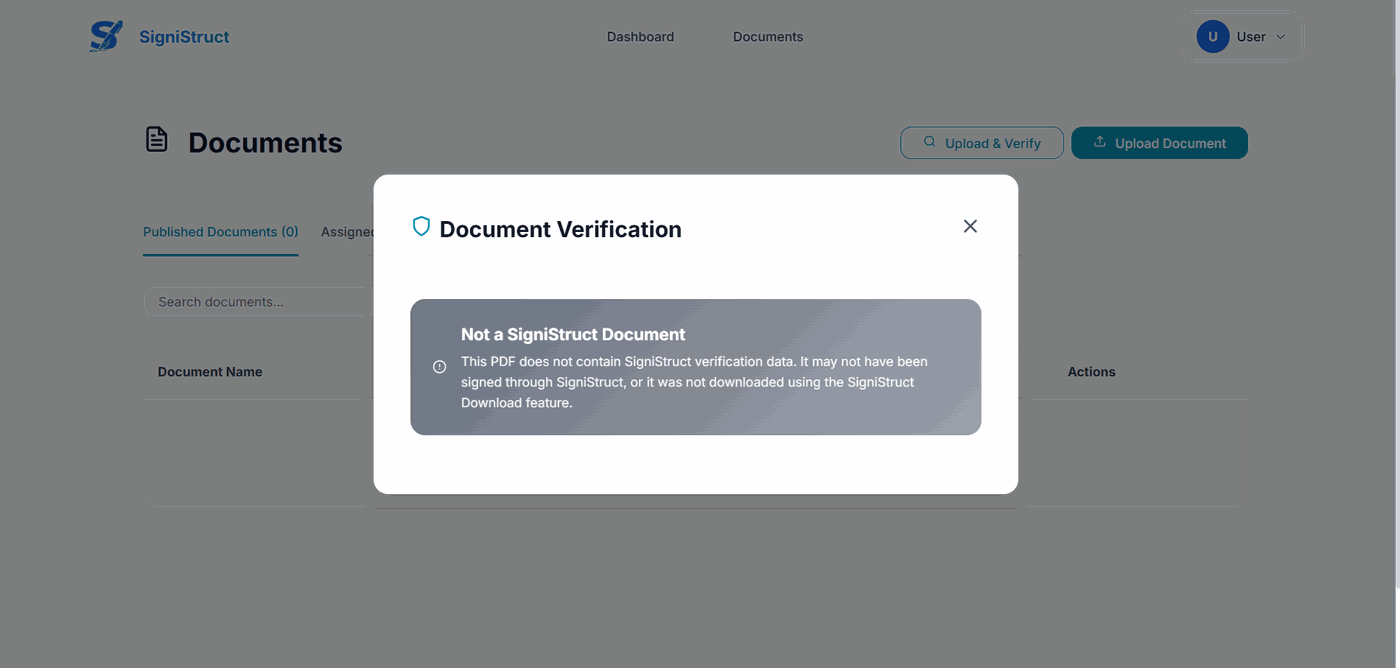
Checks authenticity and logs signing activity for compliance and traceability.
Architecture & Processing Flow
1. User authenticates and enters the protected React workspace.
2. The user creates, opens, or uploads a form/document through the front end.
3. The UI sends document and signature actions through API service layers to the
backend.
4. MongoDB stores metadata while GridFS handles larger PDF/file payloads.
5. Signing services apply cryptographic signatures, certificate checks, and multi-signer
state updates.
6. Verification and audit services confirm authenticity and return the final signed status
to the UI.
The backend is organized as a service-driven system where controllers stay thin and the real business logic lives in focused services such as signing, verification, certificates, encryption, email, and multi-signer orchestration. That separation makes it easier to reason about sensitive operations like RSA-based signing and certificate validation, while keeping the API surface clean and maintainable. It also suggests the app was built to support asynchronous workflows, since background jobs and notification services are part of the architecture.
The data model is structured around the document-signature lifecycle rather than a single monolithic record. Separate collections for documents, document signatures, signers, signing requests, user signatures, certificates, and audit logs make it possible to track state transitions precisely and preserve provenance. Pairing those models with GridFS-backed file storage is a strong fit for PDF-heavy workflows, because it keeps binary files out of the core metadata records while still linking everything back to the same document workflow.
Project Impact
SigniStruct transforms document approval workflows by replacing manual signing processes with a secure, certificate-backed digital platform. It gives organizations a single workspace to create, manage, sign, and verify documents while maintaining a tamper-proof chain of authenticity from draft to final approval.
For document reviewers and signers, the platform removes the delays of physical handoffs and fragmented email chains. Multi-signer workflows, tokenized signing routes, and RSA-backed verification ensure that every approval is structured, traceable, and cryptographically validated without requiring signers to manage complex tooling.
Ultimately, SigniStruct establishes a strong foundation of document accountability. By pairing immutable audit logs with certificate management and GridFS-backed file storage, the system ensures that every signed document can be independently verified and traced back to its signers long after the workflow is complete.