Filipizen
Filipizen is a Philippine local-government services portal that connects citizens, LGU staff, and system administrators in one platform. It streamlines QR-based sign-in, service discovery, transaction submission, status tracking, and administrative operations for public service delivery.
System Objectives
Public Discovery & LGU Selection
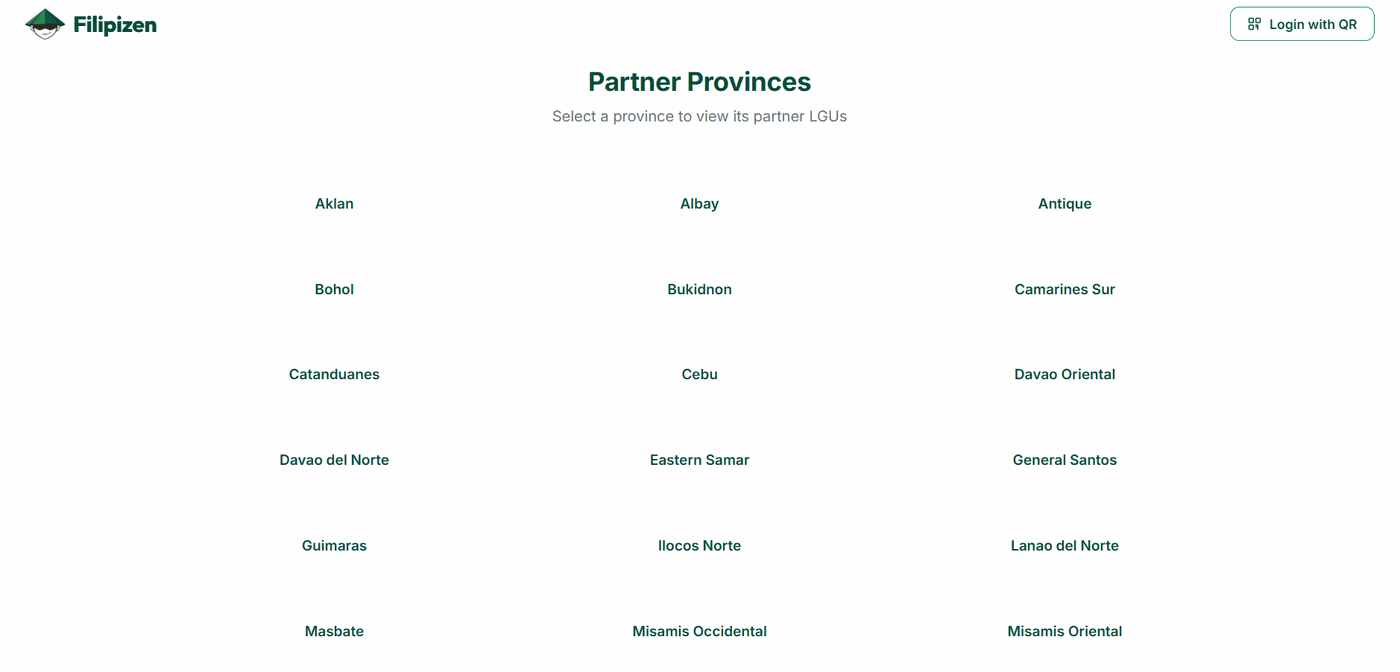
Province Search
The homepage lets users search provinces and LGUs from cached platform data before they ever log in.
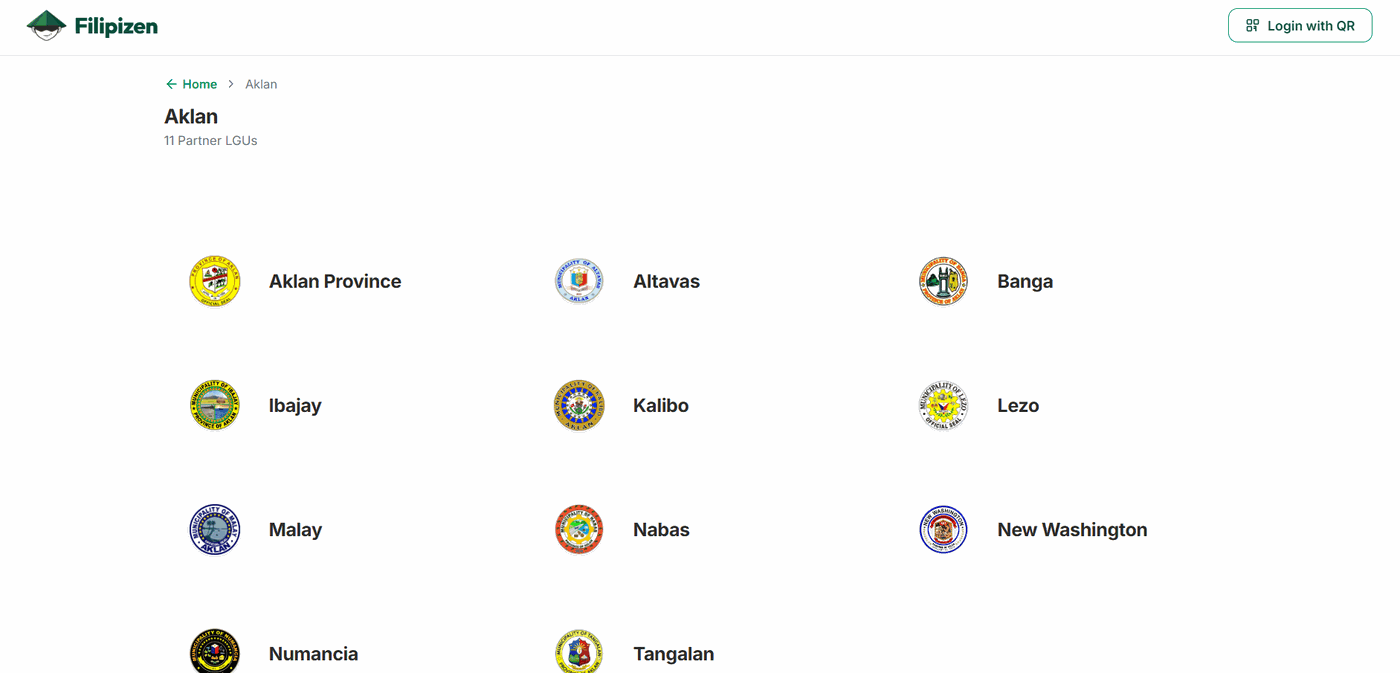
Province-to-LGU Browsing
Province pages dynamically load the regional partner LGUs and present them as interactive selection cards.
LGU Service Gating
LGU pages smartly constrain access solely to services mapped within their `offeredTransactions` matrix configurations.
Payment Lookup
A quick-access module permits external users to perform a receipt lookup using ID validation, untethered from account walls.
Citizen QR Login & Self-Service
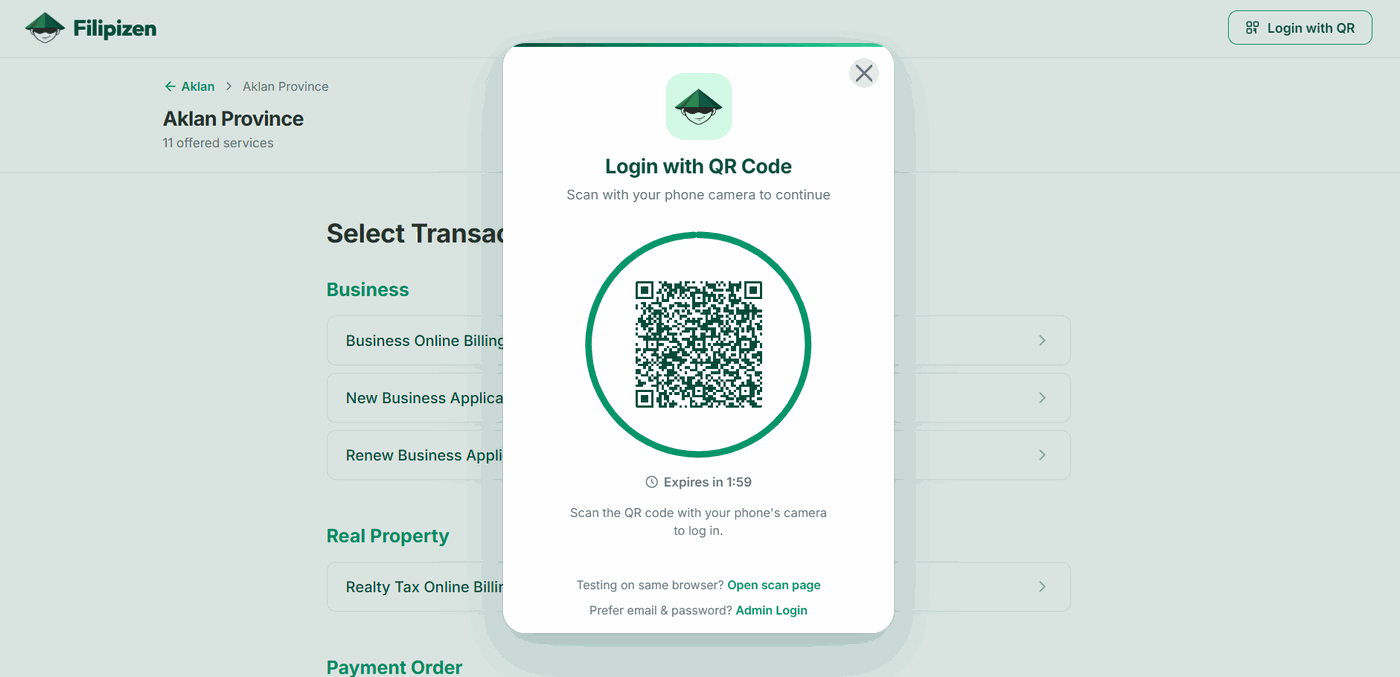
QR Session Creation
Desktop access creates a secure, temporarily-living WebSocket bound payload converted dynamically into a scan target.
PKI Device Login
Registered mobile devices intercept challenges, applying a cryptographically signed localized response verifying ownership seamlessly.
Dynamic Service Submission
Wizards guide complex nested logic (Region -> LGU -> Service -> Content -> Submit) feeding accurately assembled payloads back.
Transaction Tracking
Visual timelines map requests over time alongside aggregate metadata and notification pushes natively.
LGU & Platform Administration
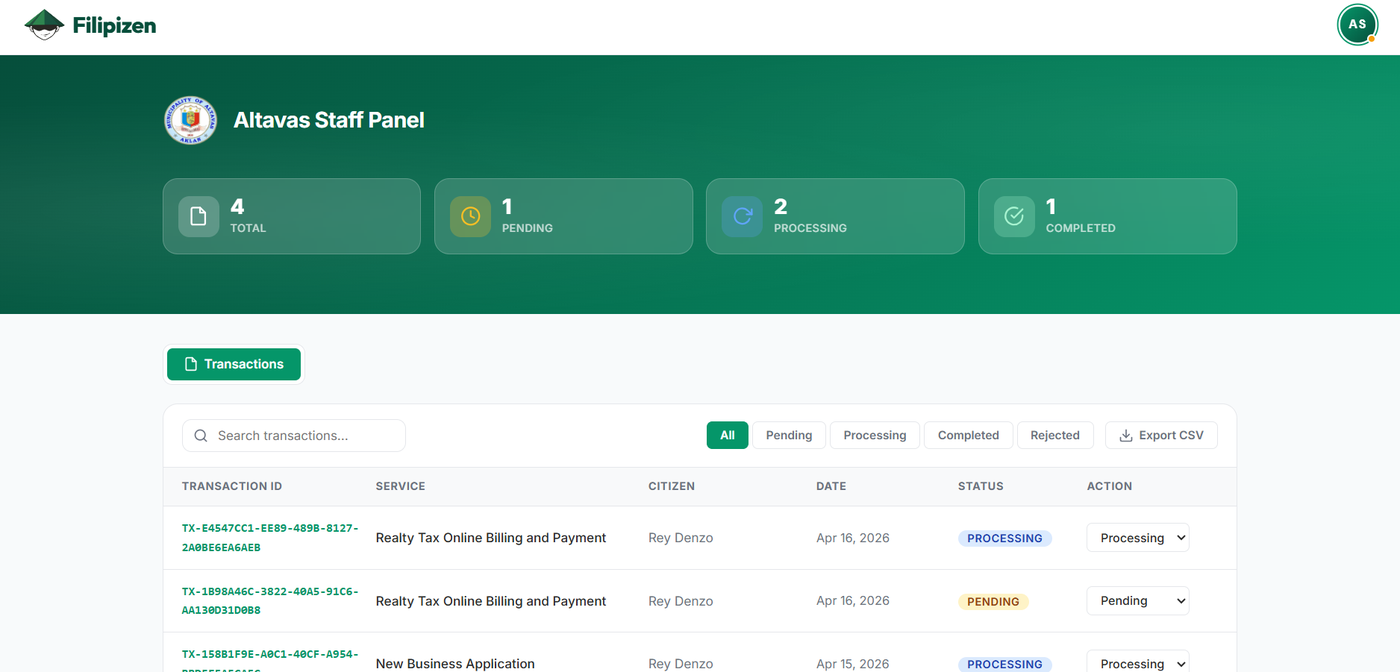
Transaction Queue Management
Local government actors sift unhandled queues, mutate transactional statuses, and broadcast contextual push messages dynamically.
Service Configuration
LGU managers natively throttle or unleash internal capabilities independently, regulating operations load rapidly without manual engineering.
Platform Governance
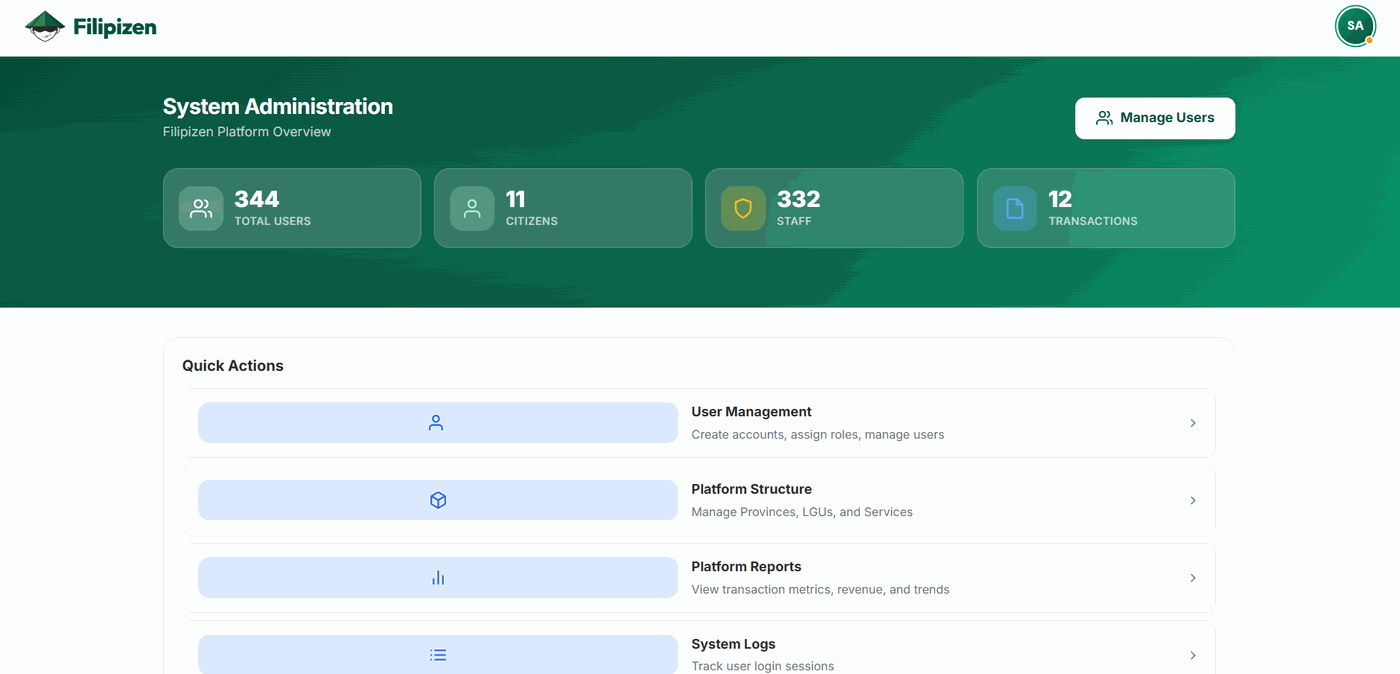
Architect tier system actors have comprehensive database CRUD capacities spanning regions, sub-LGUs, system users, and architecture dependencies.
Reporting and Audit Views
Central intelligence gathers metrics, visual chart maps, and immutable tracking of key administration activity for high-integrity retention.
Architecture & Processing Flow
The architecture separates public browsing, citizen operations, and administrative control
into cleanly decoupled boundaries. React-driven route-level lazy loading combined with
precomputed skeleton caching ensures operations remain extremely lightweight visually.
Internal authorization leverages a strictly defined custom ProtectedRoute
utilizing encapsulated role-based helpers to halt exploitation laterally.
In the physical datastore layout, workflows rely heavily on embedded meta-aggregates. The
transaction pipeline itself embeds an immutable statusHistory array,
guaranteeing every actor's state mutation is historically preserved. Transient logic heavily
leverages MongoDB TTL indexes for pruning stale notifications and WebSockets automatically,
and dynamically manages payloads via projection to bypass severe network bloat.
Project Impact
Filipizen radically modernizes local government unit (LGU) operations by stripping away bureaucratic friction and replacing long physical queues with instant, accessible digital workflows. By bridging the gap between citizen requests and localized service delivery, the platform empowers constituents to handle civic duties directly from their mobile devices, drastically decreasing wait times and administrative bottlenecks.
For local governments, the system acts as a digital catalyst, transitioning fragmented manual processes into a unified, measurable dashboard environment. This eliminates data silos, reduces human error in processing, and provides administrators with real-time insight into the operational efficiency of different civic departments.
Filipizen fosters a highly transparent, accountable, and scalable ecosystem. By ensuring that transactions are trackable, secure, and easily auditable, it restores public trust in local governance and sets a new technical standard for how civil services can be delivered effectively.