DecisionPulse
A course acceptance probability system for incoming first-year students. It helps users gauge how likely they are to confirm a chosen program by combining academic background, personal preferences, and course-fit questions into a fast, data-driven recommendation.
Core Objectives
Program Selection & Model Loading
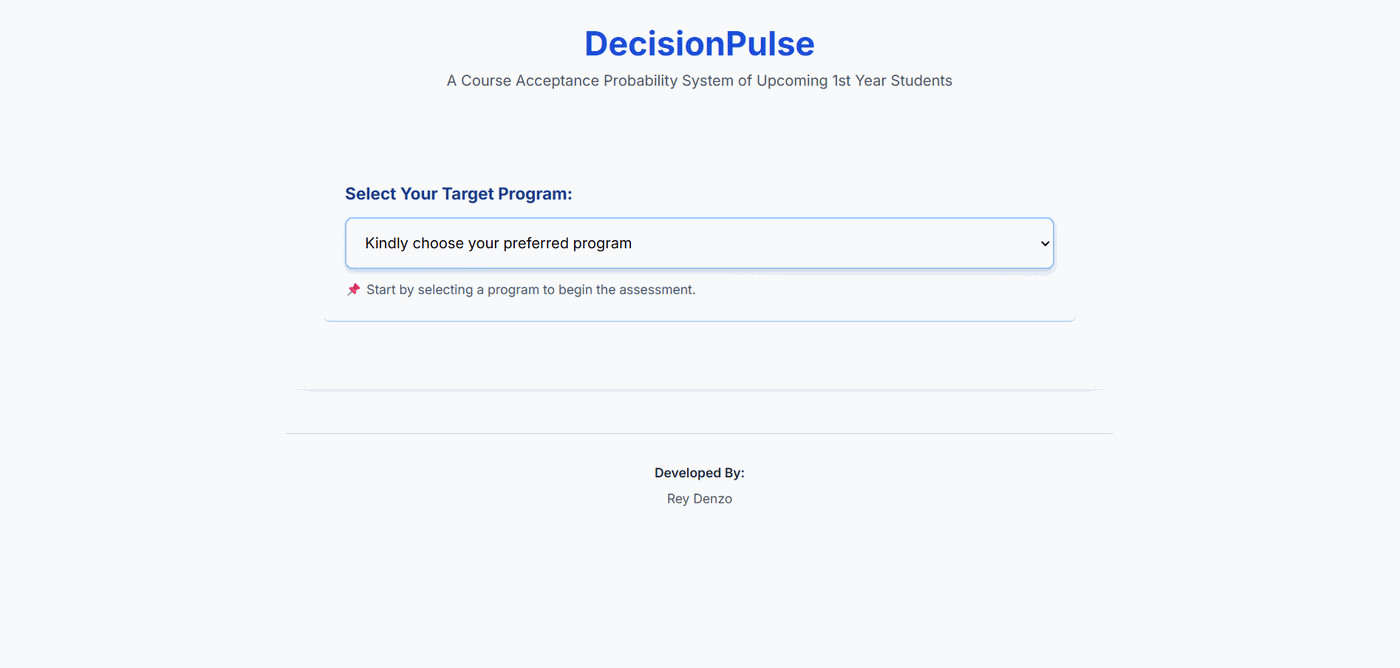
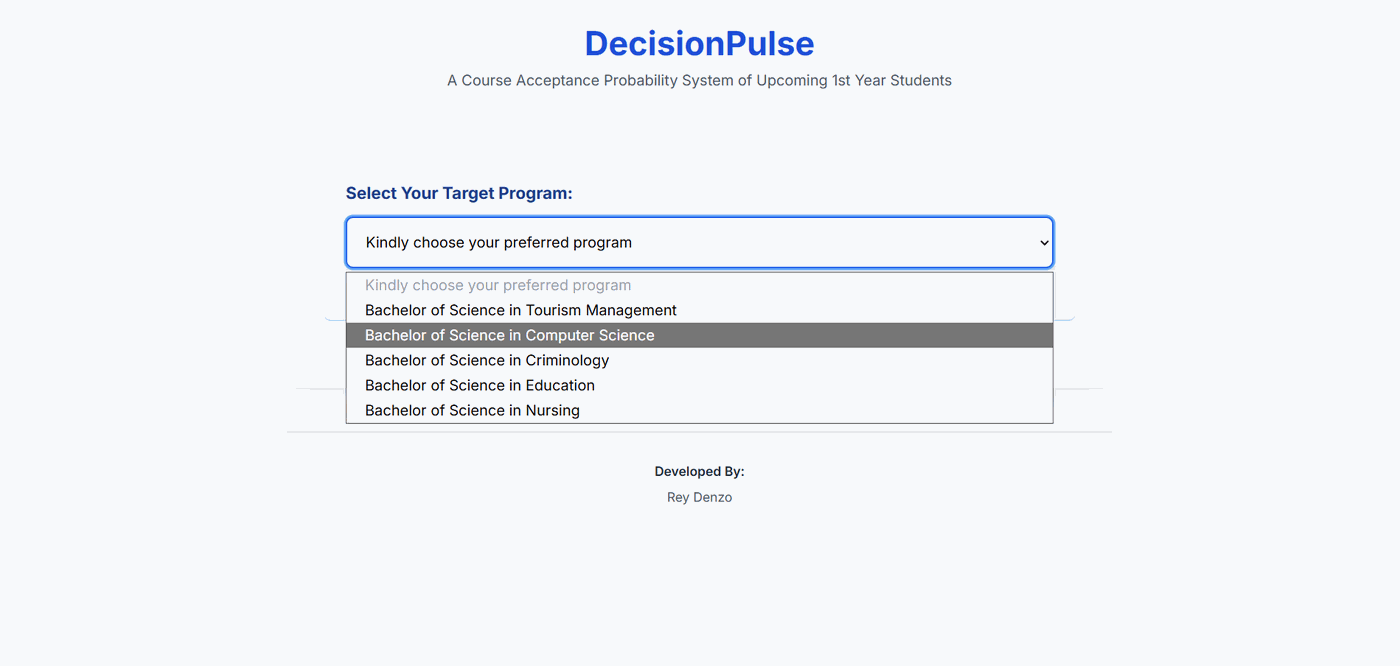
Program Picker
Users choose a target degree from a list of five supported programs before the form appears.
Dynamic Model Switch
The app swaps the active coefficient set and question bank based on the selected program.
Contextual Heading
The form updates its section title to reflect the chosen course, reinforcing the assessment context.
Hidden-to-Visible Flow
The prediction form stays hidden until a program is selected, keeping the interface focused.
Personalized Assessment Form
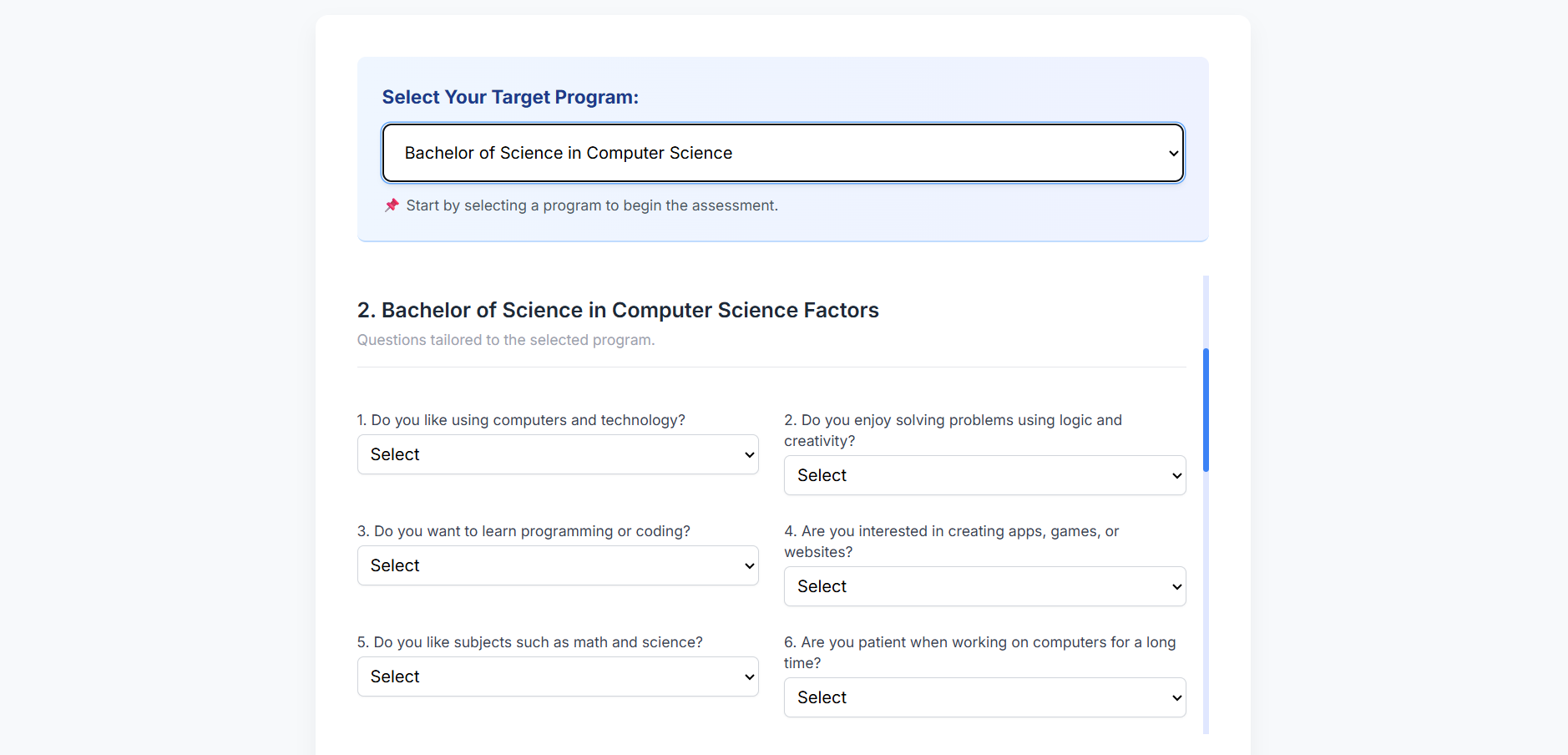
Academic Profile Inputs
The form captures GWA, SHS strand, high school type, and honors status as baseline predictors.
Program-Specific Questions
Each course gets its own 10-question set tailored to the strengths and motivations relevant to that field.
General Decision Factors
Shared questions cover interest alignment, confidence, family support, finances, location, and alternative applications.
Client-Side Validation
Required fields and GWA bounds are checked before prediction is allowed.
Prediction Result & Feedback
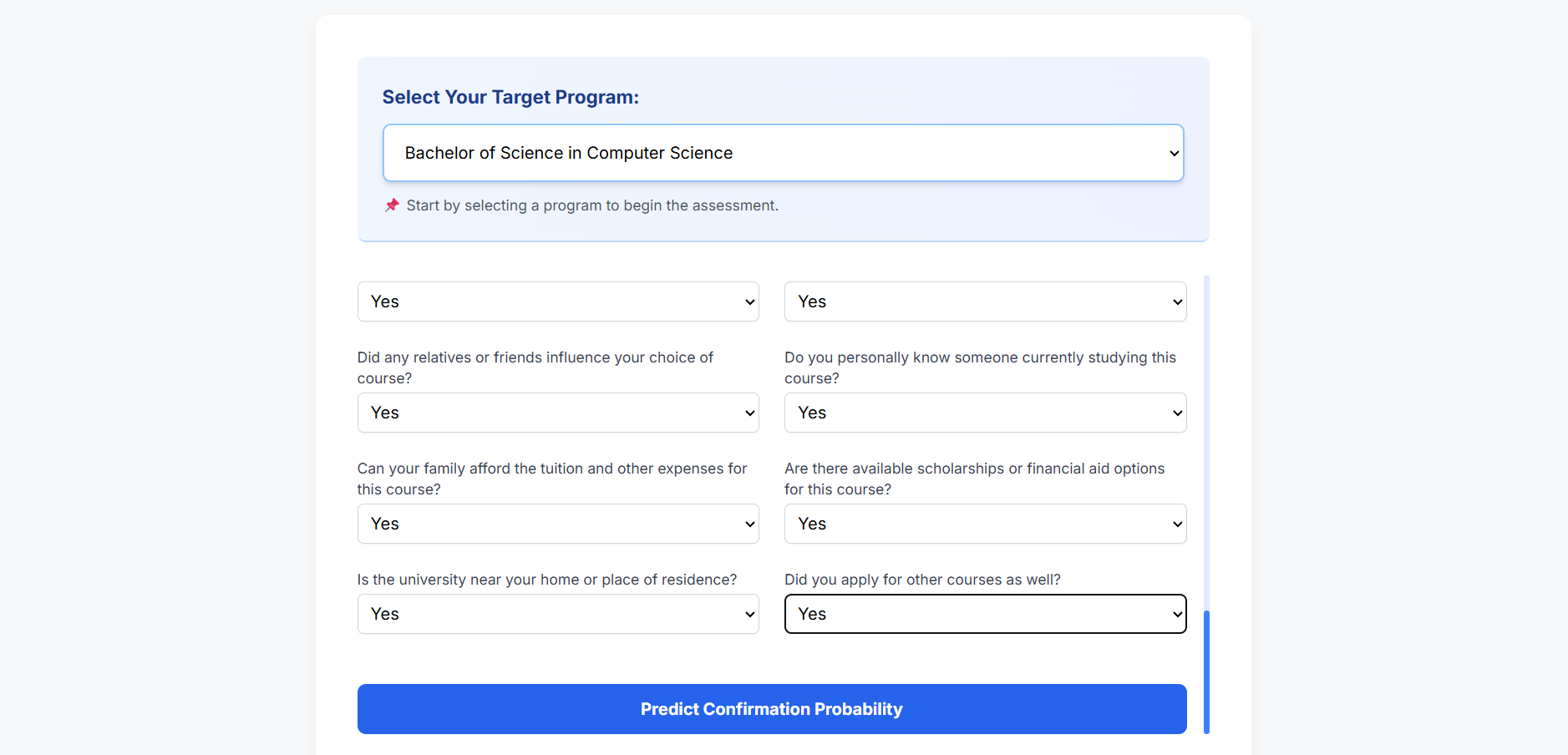
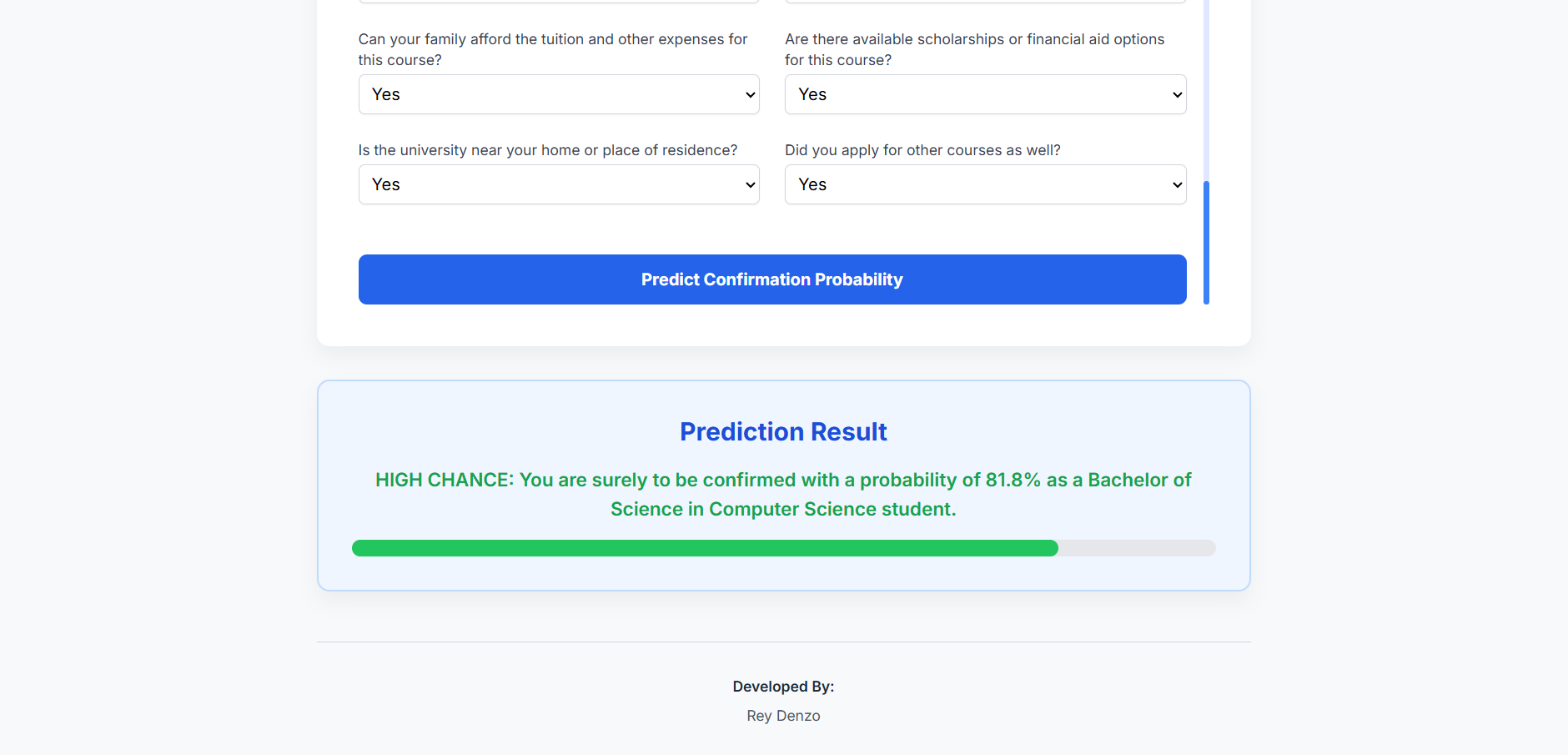
Logistic Probability Engine
The app computes a logit score from the selected model and converts it into a confirmation probability.
Color-Coded Outcome
Results are labeled as high, moderate, or low chance using green, yellow, or red feedback states.
Progress Visualization
A smooth progress bar animates to match the final probability percentage.
Immediate Guidance
The result appears instantly on the page without navigation or page reloads.
Architecture & Processing Flow
1. User selects a target program from the dropdown.
2. The app loads the matching model object and dynamically inserts the relevant course-specific questions.
3. The user fills in academic background fields, program-specific questions, and general decision factors.
4. The form validates required inputs and checks whether GWA falls within the allowed range.
5. The browser scales GWA, maps categorical answers to feature coefficients, and computes a logistic score.
6. The sigmoid output is converted into a confirmation probability and rendered as a labeled result with an animated progress bar.
The front-end is organized around a model registry pattern, where each course has its own intercept, coefficient table, and question set. That makes the app easy to extend because the UI and scoring logic are driven by data rather than hard-coded per-screen branches. The question renderer also keeps the form lightweight by generating inputs dynamically from the active model instead of duplicating HTML for each course.
The offline Python pipeline is the other major architectural piece. It reads the Excel dataset, selects relevant features, encodes binary responses, one-hot encodes categorical columns, imputes missing values, normalizes GWA, and applies SMOTE to balance the training data. It then trains and evaluates logistic regression and random forest models, with the logistic regression coefficients effectively informing the browser-side scoring logic. This split between offline model preparation and client-side inference keeps the runtime simple while still preserving a data-driven decision model.
Project Impact
DecisionPulse fundamentally improves the student enrollment process by replacing subjective guesswork with data-driven predictive modeling. It bridges the gap between raw applicant data and actionable insights, calculating course confirmation probabilities based on historical patterns to help universities accurately gauge incoming cohort sizes.
For the students themselves, the platform serves as a personalized pre-enrollment self-assessment tool. By providing a clear, color-coded probability score and targeted program questions, it empowers incoming freshmen to make confident, well-aligned choices regarding their field of study, mitigating future dropout risks.
Ultimately, DecisionPulse optimizes university resource allocation. By giving administrators advanced visibility into likely admission outcomes, the application drives more efficient capacity planning, smarter outreach, and a more streamlined, data-backed approach to higher education enrollment.